The first batch.
Three friends, one copper pot, and what a weekend of distilling teaches about lag, judgment and patience.
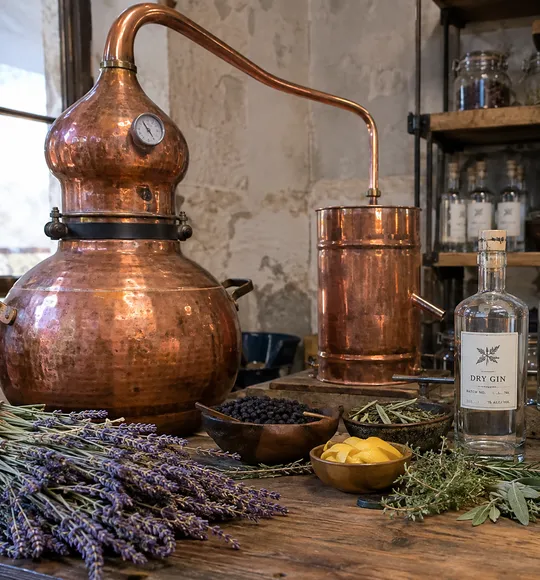
Three friends, one copper pot, and a shared conviction that this could not be that hard. It was harder than that, and better.
the night beforeWe started the night before. Juniper berries, cracked under the flat of a knife until the kitchen smelled like cedar after rain, went into the pot with neutral spirit, a little coriander, a curl of orange peel, and a fistful of dried hibiscus. Within an hour the liquid had turned garnet. Someone held a glass of it to the light and announced that our gin would be pink. We agreed and went to bed pleased with ourselves.
Maceration asks nothing of you except time. The botanicals give up their oils at their own pace. You can stir, and we did, more often than was useful, but the work belongs to the spirit and the hours. It was the first lesson of the weekend: the steps that look idle are often the ones doing the most.
lesson two: lagThe next morning we lit the burner and learned the second lesson. A copper pot does not reward impatience. Turn the heat up and nothing happens. Turn it up again and still nothing, until suddenly everything happens at once. Copper carries heat beautifully, but the liquid inside has its own inertia, and the system lags the input by twenty minutes or more. Every control engineer knows this in the abstract. Standing over a thermometer that refuses to move, you learn it in your hands. The answer to lag is not more force. It is smaller adjustments and longer waits, which is advice almost nobody follows the first time.
headsWhen the first drops came, they came fast and smelled sharp and solvent, like a nail salon. These were the heads, the lightest and harshest compounds, and they went into a jar to be thrown away. We had read about the cut. We had not anticipated how uncertain we would feel making it. No light turns green. There is only a smell that softens, a sweetness arriving underneath the sharpness, and three people passing a small glass back and forth trying to agree on when the change has happened.
That turned out to be the best part of the day. One of us had the best nose. One kept the notes: time, temperature, volume in each jar. One kept the heat steady and the conversation honest. None of us could have made the cuts alone with any confidence. Together, comparing what each of us noticed, we made calls we were willing to stand behind. A good process does not remove judgment. It creates the conditions for judgment to be exercised well, and it records enough that the judgment improves next time.
A good process does not remove judgment. It creates the conditions for judgment to be exercised well.
hearts, then tailsThe hearts ran most of the afternoon, slow and clean, juniper rising through them like pines seen through fog. When the smell turned heavy and damp, like wet cardboard, we moved to the tails jar and shut the burner down.
color does not distillThe surprise came when we held the jars up to the window. The spirit was perfectly clear. The garnet we had admired the night before stayed behind in the pot with the spent hibiscus. Color does not distill. Only what is volatile enough to rise makes the crossing. Whatever the hibiscus gave us, if it gave us anything, will have to be found by taste rather than sight.
There is a lesson there for anyone who designs systems for a living. The most visible features of an input are not always the ones that survive the process. A pilot can look impressive while the value that actually reaches the other end is something quieter and harder to measure. You learn what a process truly carries across only by running it and paying close attention to what comes out.
We do not yet know whether our gin is any good. It is resting in glass, rounding off its edges, and we have agreed not to judge it for two more weeks. That is a design choice too. Evaluation that comes too early measures the wrong thing.
What we do know is what the copper taught. Respect the lag. Make the cuts together. Write everything down. Wait longer than feels necessary. Whatever is in those jars, the first batch has already done its job. It has made the second one possible.